


W1106A Toner Cartridge Buying Guide for Small Businesses & Print Shops in Africa
source: Time:2026-10-10 views:31
W1106A Toner Cartridge Buying Guide for Small Businesses & Print Shops in Africa
Choosing the right W1106A toner cartridge matters when every printed invoice, school handout, receipt, quotation, and client proof has to look clean without slowing down your day. This guide covers what African small businesses and print shops should check before buying, how to estimate real value, and how to avoid mistakes that waste stock. The HP 106A W1106A is a black standard-capacity cartridge for selected compact HP Laser printers, so a good purchase starts with compatibility, print volume, and supplier reliability.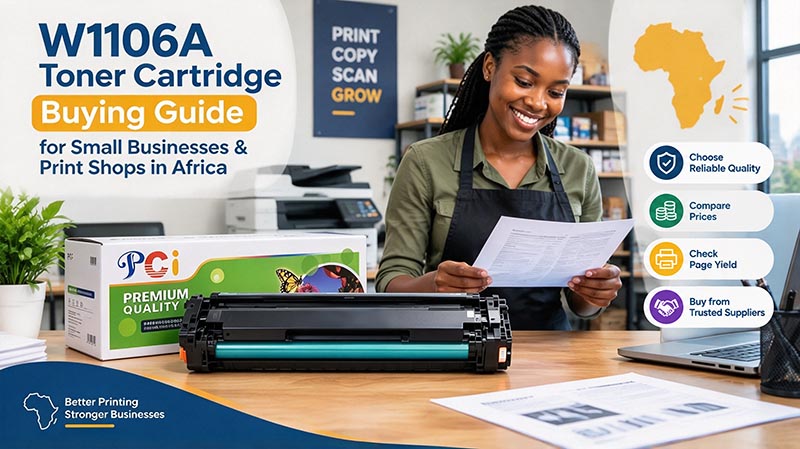
What should buyers know before choosing a W1106A toner cartridge?
Buyers should first confirm that the cartridge code, printer model, expected page volume, and supplier terms all match their needs. HP lists the HP 106A Black Original Laser Toner Cartridge as product code W1106A, a black standard-capacity cartridge with an approximate yield of 1,000 pages. HP also states that HP 106 toner cartridges work with the HP Laser 107, 135, 137, and 139 printer families. (hp.com)That makes the w1106a toner cartridge a fit for businesses that print regular black-and-white documents but do not need a large enterprise cartridge. For a shop printing customer forms, delivery notes, internal records, or short-run office jobs, it is a solid everyday consumable. For a print shop running heavy daily batches, it still works, but stock planning matters more because standard-capacity cartridges need replacing more often than high-yield options in other printer families.
Compatibility comes before price
The most expensive toner mistake is buying a cartridge that looks similar but does not work in your printer. Cartridge naming gets confusing because sellers may write the same item as hp 106a w1106a, toner 106a w1106a, 106a w1106a, hp w1106a toner, or simply w1106a toner. Those phrases usually point to the same cartridge family, but the safe move is to match the exact printer model and cartridge code before paying.
For small businesses across Africa, this matters because returns get difficult when a supplier is in another city or country. A cartridge bought in a hurry from an online marketplace may arrive after several days, only for the team to discover it fits a different regional model or printer series. Always check the printer label, printer menu, manual, or current cartridge before ordering.
Use this quick compatibility checklist before purchase:
Confirm the printer family: Match your device against HP Laser 107, 135, 137, or 139 compatibility guidance where relevant. (hp.com)
Check the cartridge code: Look for W1106A, not just "106A," because product codes help reduce mix-ups.
Compare seller photos with caution: Packaging images can vary, and photos alone are not proof of compatibility.
Ask for written confirmation: If buying from a distributor or reseller, request the compatible printer models on the invoice, quote, or message thread.
Keep one used cartridge: It gives your procurement person a physical reference when reordering.
Original, compatible, and remanufactured toner options
A W1106A Toner Cartridge Buying Guide for Small Businesses & Print Shops in Africa should be honest about the three common buying routes: original HP toner, compatible toner, and remanufactured toner. Original cartridges are made by the printer brand for the specified devices. HP says its Original HP Laser Toner Cartridges give consistent prints and reliability on compact HP Laser printers. (hp.com)
Compatible cartridges are new cartridges made by third-party manufacturers. They can be attractive when upfront cost is the main concern, but quality depends heavily on the manufacturer, chip reliability, packaging, and supplier support. Remanufactured cartridges are previously used cartridges that have been cleaned, refilled, and rebuilt for resale. They may reduce waste and cost, but performance can vary if the remanufacturing process is weak.
For a small office, one poor cartridge can waste staff time. For a print shop, it can also waste paper, delay customer jobs, and damage trust. The decision should not be based only on the lowest shelf price. It should include output consistency, return policy, defect handling, and the cost of reprinting failed pages.
How do you calculate the real cost of toner 106A W1106A?
The real cost is the cartridge price divided by the number of usable pages you expect to print, plus the hidden costs of downtime, reprints, delivery, and returns. HP lists the HP 106A W1106A page yield at approximately 1,000 pages, so buyers can use that figure as a planning baseline rather than a guarantee for every print job. (hp.com)A simple cost-per-page formula is:
Take the cartridge purchase price.
Divide it by the expected number of printed pages.
Add delivery fees if they apply.
Add estimated waste if your work involves dense graphics, heavy coverage, or many test prints.
Compare the result across suppliers, not just the headline cartridge price.
For example, a cartridge used mostly for text invoices will usually behave differently from one used for dense black forms, page borders, or artwork proofs. A print shop producing certificates, forms, or booklets should track how many finished pages each cartridge actually delivers. After two or three cartridges, your own records will beat any generic estimate.
Stock planning for African small businesses and print shops
Supply planning matters more where delivery routes, customs delays, currency changes, or local stock shortages can affect availability. Even when the hp w1106a toner is easy to find in major cities, smaller towns and fast-growing business districts may face longer replacement times. A basic reorder system prevents last-minute buying at inflated prices.
A simple stock rule is to keep one working cartridge in the printer and one sealed spare in storage. Print shops with daily customer work may need two or more spares, depending on average monthly use. If your business prints payroll documents, exam materials, tenders, medical forms, or delivery notes, running out of toner is not a small inconvenience. It can stop revenue or delay important service.
Create a simple toner log with these fields:
Cartridge code: W1106A or HP 106A W1106A
Supplier name and contact
Purchase date
Installation date
Page counter reading at installation
Page counter reading at replacement
Any print defects or error messages
Staff member who approved the purchase
This record helps you identify reliable suppliers, spot cartridges that underperform, and forecast demand before peak seasons. It also reduces confusion when more than one employee handles purchasing.
Supplier reliability matters as much as cartridge quality
A low price is useful only when the seller can deliver the correct cartridge, on time, in good condition, and with a clear return process. In many African markets, businesses buy toner through a mix of local stationery shops, IT resellers, office equipment dealers, and online marketplaces. Each channel can work well, but each needs basic checks.
Before placing a repeat order, ask whether the supplier provides tax invoices, product codes on quotes, delivery tracking, warranty or return terms, and support if the printer rejects the cartridge. If they sell compatible or remanufactured toner, ask who manufactures it and what happens if it leaks, prints faintly, or causes repeated errors. A professional supplier should answer clearly without pushing you to buy before you verify the model.
The best reseller relationship is not just transactional. It helps your business avoid emergency purchases, choose the right toner, and maintain consistent document quality. For print shops, that relationship can protect turnaround time during busy weeks.
Storage and handling protect print quality
Toner is more stable than liquid ink, but storage still matters. Keep sealed cartridges in a clean, dry place away from direct sun, heat, dust, and heavy pressure. Do not store boxes where they may be crushed by paper reams, cleaning chemicals, or other office supplies.
When installing a w1106a toner cartridge, follow the printer instructions and avoid touching sensitive cartridge surfaces. If a cartridge has been transported over a long distance, let it settle at room temperature before installation. Train staff to replace toner calmly instead of forcing parts into place; hurried handling can cause spills, broken tabs, or unnecessary service calls.
For print shops, assign toner handling to trained staff. A quick two-minute routine can prevent many avoidable problems: check the cartridge code, inspect packaging, install carefully, print a test page, and record the date.
Red flags when buying W1106A toner
Counterfeit, poorly stored, or low-grade toner can create more cost than it saves. Be cautious when a deal looks far below the normal market range, the seller refuses to confirm the product code, or packaging appears damaged. Also be careful with vague listings that say "fits HP printers" without naming the exact compatible models.
Watch for these warning signs:
No clear W1106A or 106A W1106A product code in the listing
Blurry product photos or mismatched packaging images
No return policy for unopened incorrect items
No support if the printer displays a cartridge error
Seller pressure to buy quickly without checking printer model
Unusually poor print samples, fading, streaks, or toner dust after installation
If your business prints documents for customers, contracts, schools, clinics, or government submissions, consistent output is part of your reputation. A toner decision is also a service-quality decision.
A simple buying process
Use a repeatable process instead of treating toner as a last-minute office errand. Start by confirming the printer model, then decide whether original, compatible, or remanufactured toner fits your risk tolerance and budget. Next, compare total cost, delivery time, support, and supplier reputation.For most small businesses, the safest approach is to standardize purchasing. Choose approved suppliers, document acceptable cartridge types, and keep a reorder level. For print shops, review cartridge performance every month so you know which option produces the best balance of cost, reliability, and customer-ready output.


