


How Much Money Can You Save With Compatible Color Toner Cartridges? Real Cost Examples
source: Time:2026-07-02 views:122
How Much Money Can You Save With Compatible Color Toner Cartridges? Real Cost Examples
Color laser printing can get expensive faster than many offices expect. The printer itself may not cost much, but replacing the toner cartridges several times a year can easily become one of those small recurring expenses that adds up.
This is why many home offices, schools, and small businesses compare OEM toner cartridges with compatible toner cartridges. OEM cartridges are made by the original printer brand, such as HP, Brother, Canon, or Xerox. Compatible cartridges are made by third-party manufacturers and are designed to work with the same printer models.
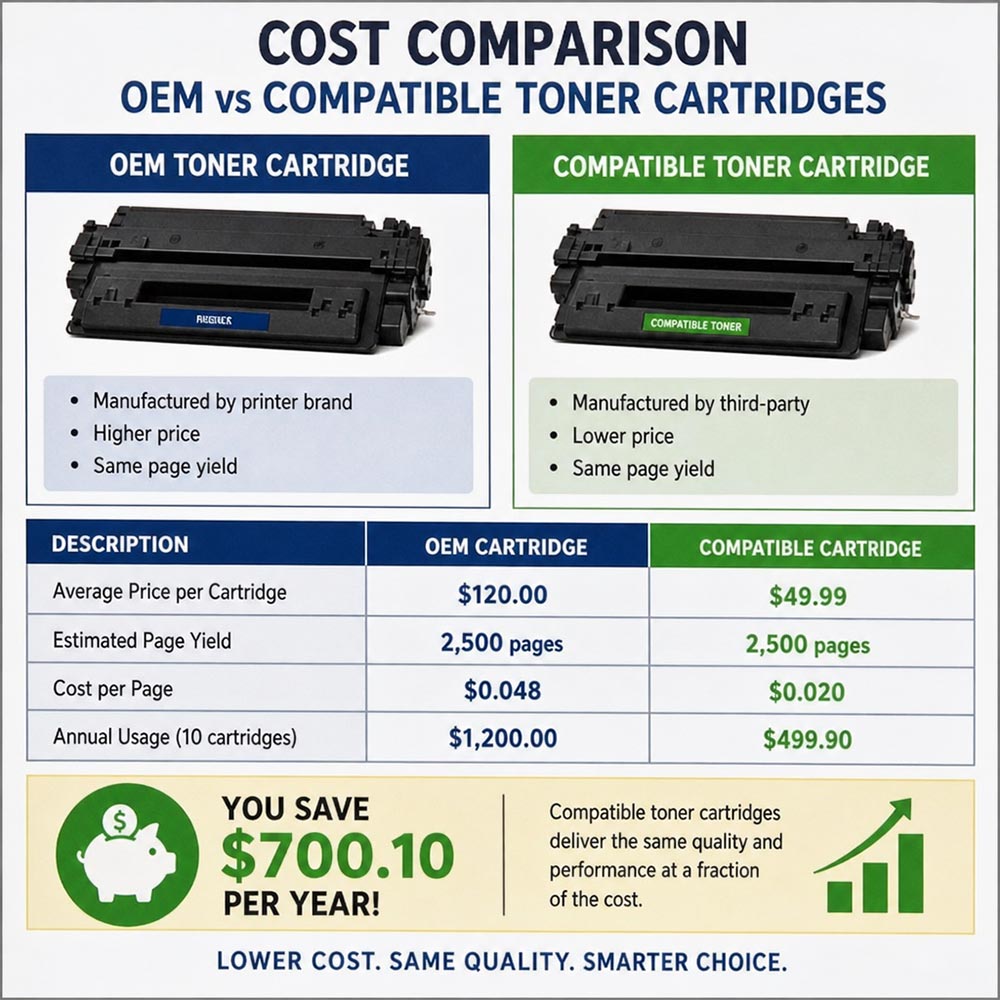
The biggest reason people switch is simple: price. In many cases, compatible color toner cartridges cost 40% to 70% less than OEM cartridges. The exact savings depend on the printer model, whether you buy standard-yield or high-yield cartridges, and how often you print.
Below, we will look at real-world cost examples and show how much you may actually save.
A color laser printer usually uses four cartridges:
Black
Cyan
Magenta
Yellow
If you replace all four at the same time, OEM toner can become expensive. For example, a full OEM color toner set for a popular HP, Brother, or Canon laser printer may cost anywhere from $250 to $500, depending on the model and page yield.
A compatible four-pack for the same printer may cost around $70 to $180.
Here is a simple example:
OEM color toner set: $320
Compatible color toner set: $95
Savings per set: $225
Savings percentage: about 70%
This does not mean every compatible toner purchase saves exactly 70%. Some models save less. Some high-yield cartridges save more. But the price difference is large enough that it is worth calculating before automatically buying OEM toner.
Example 1: Small Office Printing 1,000 Pages per Month
Let’s say a small office prints about 1,000 color and black-and-white pages per month. The office replaces a full set of toner cartridges about three times per year.
If the OEM toner set costs $320:
$320 x 3 sets per year = $960 per year
If a compatible toner set costs $95:
$95 x 3 sets per year = $285 per year
Estimated annual savings:
$960 - $285 = $675 per year
For a small office, saving $675 a year may cover other office supplies, software subscriptions, or part of a printer upgrade.
Example 2: Business Replacing Toner Every Month
Now consider a busier office that replaces one full set of color toner cartridges every month. This could be a marketing team, school office, real estate agency, or small print-heavy business.
If the OEM set costs $350:
$350 x 12 months = $4,200 per year
If the compatible set costs $120:
$120 x 12 months = $1,440 per year
Estimated annual savings:
$4,200 - $1,440 = $2,760 per year
In this case, switching to compatible toner could reduce annual toner spending by more than half. For businesses with multiple printers, the savings can be even higher.
Example 3: High-Yield Toner Cartridges
High-yield cartridges usually cost more upfront but print more pages. This makes them useful for offices with regular printing needs.
For example:
OEM high-yield black toner: $150
Page yield: 7,500 pages
Cost per page: $0.02
Compatible high-yield black toner: $55
Page yield: 7,500 pages
Cost per page: $0.007
In this example, the compatible cartridge saves about 1.3 cents per page. That may sound small, but it adds up.
If you print 20,000 pages per year:
OEM estimated cost: $400
Compatible estimated cost: $140
Estimated savings: $260 per year
For color printing, the difference can be even larger because you are replacing multiple cartridges instead of only one black cartridge.
Use this formula:
Cartridge price / page yield = cost per page
For example:
$120 cartridge / 2,400 pages = $0.05 per page
If a compatible cartridge costs $45 and has the same estimated yield:
$45 / 2,400 pages = $0.018 per page
That means the compatible cartridge costs about 1.8 cents per page, while the OEM cartridge costs 5 cents per page.
For an office printing 10,000 pages per year, the difference would be:
OEM: 10,000 x $0.05 = $500
Compatible: 10,000 x $0.018 = $180
Estimated savings: $320 per year
When comparing toner, always check the page yield. A cheaper cartridge is not always the better deal if it prints far fewer pages.
Will Compatible Color Toner Affect Print Quality?
For everyday business documents, invoices, reports, shipping labels, school materials, and internal handouts, many users find compatible toner good enough for regular use.
A good compatible color toner cartridge should produce:
Clear black text
Readable small fonts
Consistent color charts and graphics
Clean pages without streaks or toner spots
Page yields close to the advertised amount
However, it is important to be realistic. Compatible toner may not always match OEM toner perfectly in color accuracy. If you print brand-sensitive marketing materials, professional photos, product packaging proofs, or design samples, OEM toner may still be the safer option.
For most office printing, though, the difference is often small enough that the savings outweigh the slight variation in color.
Common issues with low-quality compatible toner include:
Printer not recognizing the cartridge
Chip compatibility problems after printer firmware updates
Streaks, faded prints, or uneven color
Toner leakage
Lower-than-advertised page yield
Poor customer support
These problems are why it is better to buy from a supplier that clearly lists compatible printer models, page yield, chip information, and return policy.
Before buying, check whether the listing says:
With chip or no chip
Compatible with your exact printer model
Standard yield or high yield
Estimated page yield
Warranty or satisfaction guarantee
Return policy for defective cartridges
This is especially important for newer HP, Canon, Brother, and Xerox printers, because some models rely heavily on toner chips.
That said, poor-quality cartridges can cause problems. A leaking cartridge, for example, can leave toner inside the printer and create messy printouts. This is why supplier quality matters.
To reduce risk:
Avoid unknown sellers with very few reviews
Read negative reviews, not only five-star reviews
Choose cartridges with a warranty
Test one set before buying in bulk
Keep one OEM cartridge available if printing is business-critical
If your printer is still under warranty, check the warranty terms in your country. In many markets, using a compatible cartridge does not automatically void the printer warranty. However, damage caused by a defective third-party cartridge may not be covered.
Environmental Benefits of Compatible and Remanufactured Toner
Compatible and remanufactured toner cartridges can also reduce waste. Remanufactured cartridges reuse original cartridge shells, while many compatible toner suppliers use recyclable packaging or cartridge recycling programs.
The environmental benefit depends on the product type and supplier. A well-managed remanufactured cartridge program can help reduce landfill waste and lower demand for new plastic components.
If sustainability matters to your business, look for suppliers that offer:
Cartridge recycling programs
Remanufactured toner options
Recyclable packaging
Clear environmental policies
Price should not be the only factor. A slightly more expensive cartridge from a responsible supplier may be a better long-term choice than the cheapest listing available.
When OEM Toner Still Makes Sense
Compatible toner is a good choice for many users, but OEM toner still has its place.
OEM cartridges may be worth the extra cost if:
You need exact color consistency
You print customer-facing design materials
Your printer is new and you want the lowest compatibility risk
Your company policy requires OEM supplies
You have had bad experiences with third-party cartridges before
For everyday office use, compatible toner usually offers better value. For high-precision color work, OEM toner may still be the better option.
How to Choose a Good Compatible Color Toner Cartridge
To get the best balance of price and reliability, do not choose only by the lowest price. A better approach is to compare the total value.
Before ordering, check:
The exact printer model compatibility
Whether the cartridge includes a chip
The advertised page yield
Recent customer reviews
Warranty and return policy
Seller response to defective product complaints
Whether the cartridge is standard-yield or high-yield
If you are buying for a business, order one set first and test it. Print text documents, color charts, reports, and anything your office normally prints. If the results are stable, then consider buying in larger quantities.
Here is a realistic summary:
Light home office: $100 to $300 saved per year
Small office: $500 to $1,000 saved per year
Busy business printer: $2,000+ saved per year
Multiple printers: potentially several thousand dollars saved per year
The best way to know your exact savings is to compare the cost of a full OEM toner set with a compatible set for your specific printer model. Then multiply the difference by how many times you replace toner each year.
For many offices, compatible toner cartridges are one of the easiest ways to reduce printing costs without changing printers, reducing print volume, or lowering productivity. The key is to buy from a reliable supplier, check compatibility carefully, and avoid cartridges that look too cheap to be trustworthy.
Color laser printing can get expensive faster than many offices expect. The printer itself may not cost much, but replacing the toner cartridges several times a year can easily become one of those small recurring expenses that adds up.
This is why many home offices, schools, and small businesses compare OEM toner cartridges with compatible toner cartridges. OEM cartridges are made by the original printer brand, such as HP, Brother, Canon, or Xerox. Compatible cartridges are made by third-party manufacturers and are designed to work with the same printer models.
The biggest reason people switch is simple: price. In many cases, compatible color toner cartridges cost 40% to 70% less than OEM cartridges. The exact savings depend on the printer model, whether you buy standard-yield or high-yield cartridges, and how often you print.
Below, we will look at real-world cost examples and show how much you may actually save.
OEM vs. Compatible Toner: What Is the Price Difference?
A color laser printer usually uses four cartridges:
Black
Cyan
Magenta
Yellow
If you replace all four at the same time, OEM toner can become expensive. For example, a full OEM color toner set for a popular HP, Brother, or Canon laser printer may cost anywhere from $250 to $500, depending on the model and page yield.
A compatible four-pack for the same printer may cost around $70 to $180.
Here is a simple example:
OEM color toner set: $320
Compatible color toner set: $95
Savings per set: $225
Savings percentage: about 70%
This does not mean every compatible toner purchase saves exactly 70%. Some models save less. Some high-yield cartridges save more. But the price difference is large enough that it is worth calculating before automatically buying OEM toner.
Example 1: Small Office Printing 1,000 Pages per Month
Let’s say a small office prints about 1,000 color and black-and-white pages per month. The office replaces a full set of toner cartridges about three times per year.
If the OEM toner set costs $320:
$320 x 3 sets per year = $960 per year
If a compatible toner set costs $95:
$95 x 3 sets per year = $285 per year
Estimated annual savings:
$960 - $285 = $675 per year
For a small office, saving $675 a year may cover other office supplies, software subscriptions, or part of a printer upgrade.
Example 2: Business Replacing Toner Every Month
Now consider a busier office that replaces one full set of color toner cartridges every month. This could be a marketing team, school office, real estate agency, or small print-heavy business.
If the OEM set costs $350:
$350 x 12 months = $4,200 per year
If the compatible set costs $120:
$120 x 12 months = $1,440 per year
Estimated annual savings:
$4,200 - $1,440 = $2,760 per year
In this case, switching to compatible toner could reduce annual toner spending by more than half. For businesses with multiple printers, the savings can be even higher.
Example 3: High-Yield Toner Cartridges
High-yield cartridges usually cost more upfront but print more pages. This makes them useful for offices with regular printing needs.
For example:
OEM high-yield black toner: $150
Page yield: 7,500 pages
Cost per page: $0.02
Compatible high-yield black toner: $55
Page yield: 7,500 pages
Cost per page: $0.007
In this example, the compatible cartridge saves about 1.3 cents per page. That may sound small, but it adds up.
If you print 20,000 pages per year:
OEM estimated cost: $400
Compatible estimated cost: $140
Estimated savings: $260 per year
For color printing, the difference can be even larger because you are replacing multiple cartridges instead of only one black cartridge.
How to Calculate Your Own Toner Savings
The easiest way to compare toner costs is to calculate the cost per page.Use this formula:
Cartridge price / page yield = cost per page
For example:
$120 cartridge / 2,400 pages = $0.05 per page
If a compatible cartridge costs $45 and has the same estimated yield:
$45 / 2,400 pages = $0.018 per page
That means the compatible cartridge costs about 1.8 cents per page, while the OEM cartridge costs 5 cents per page.
For an office printing 10,000 pages per year, the difference would be:
OEM: 10,000 x $0.05 = $500
Compatible: 10,000 x $0.018 = $180
Estimated savings: $320 per year
When comparing toner, always check the page yield. A cheaper cartridge is not always the better deal if it prints far fewer pages.
Will Compatible Color Toner Affect Print Quality?
For everyday business documents, invoices, reports, shipping labels, school materials, and internal handouts, many users find compatible toner good enough for regular use.
A good compatible color toner cartridge should produce:
Clear black text
Readable small fonts
Consistent color charts and graphics
Clean pages without streaks or toner spots
Page yields close to the advertised amount
However, it is important to be realistic. Compatible toner may not always match OEM toner perfectly in color accuracy. If you print brand-sensitive marketing materials, professional photos, product packaging proofs, or design samples, OEM toner may still be the safer option.
For most office printing, though, the difference is often small enough that the savings outweigh the slight variation in color.
What Are the Risks of Compatible Toner Cartridges?
Compatible toner can save money, but not every cartridge is equal. The cheapest option is not always the best option.Common issues with low-quality compatible toner include:
Printer not recognizing the cartridge
Chip compatibility problems after printer firmware updates
Streaks, faded prints, or uneven color
Toner leakage
Lower-than-advertised page yield
Poor customer support
These problems are why it is better to buy from a supplier that clearly lists compatible printer models, page yield, chip information, and return policy.
Before buying, check whether the listing says:
With chip or no chip
Compatible with your exact printer model
Standard yield or high yield
Estimated page yield
Warranty or satisfaction guarantee
Return policy for defective cartridges
This is especially important for newer HP, Canon, Brother, and Xerox printers, because some models rely heavily on toner chips.
Are Compatible Toner Cartridges Bad for Your Printer?
A reliable compatible toner cartridge should not damage your printer when it is made correctly and matched to the right model. Many businesses use compatible toner for years without major issues.That said, poor-quality cartridges can cause problems. A leaking cartridge, for example, can leave toner inside the printer and create messy printouts. This is why supplier quality matters.
To reduce risk:
Avoid unknown sellers with very few reviews
Read negative reviews, not only five-star reviews
Choose cartridges with a warranty
Test one set before buying in bulk
Keep one OEM cartridge available if printing is business-critical
If your printer is still under warranty, check the warranty terms in your country. In many markets, using a compatible cartridge does not automatically void the printer warranty. However, damage caused by a defective third-party cartridge may not be covered.
Environmental Benefits of Compatible and Remanufactured Toner
Compatible and remanufactured toner cartridges can also reduce waste. Remanufactured cartridges reuse original cartridge shells, while many compatible toner suppliers use recyclable packaging or cartridge recycling programs.
The environmental benefit depends on the product type and supplier. A well-managed remanufactured cartridge program can help reduce landfill waste and lower demand for new plastic components.
If sustainability matters to your business, look for suppliers that offer:
Cartridge recycling programs
Remanufactured toner options
Recyclable packaging
Clear environmental policies
Price should not be the only factor. A slightly more expensive cartridge from a responsible supplier may be a better long-term choice than the cheapest listing available.
When OEM Toner Still Makes Sense
Compatible toner is a good choice for many users, but OEM toner still has its place.
OEM cartridges may be worth the extra cost if:
You need exact color consistency
You print customer-facing design materials
Your printer is new and you want the lowest compatibility risk
Your company policy requires OEM supplies
You have had bad experiences with third-party cartridges before
For everyday office use, compatible toner usually offers better value. For high-precision color work, OEM toner may still be the better option.
How to Choose a Good Compatible Color Toner Cartridge
To get the best balance of price and reliability, do not choose only by the lowest price. A better approach is to compare the total value.
Before ordering, check:
The exact printer model compatibility
Whether the cartridge includes a chip
The advertised page yield
Recent customer reviews
Warranty and return policy
Seller response to defective product complaints
Whether the cartridge is standard-yield or high-yield
If you are buying for a business, order one set first and test it. Print text documents, color charts, reports, and anything your office normally prints. If the results are stable, then consider buying in larger quantities.
Final Verdict: How Much Can You Save?
Most users can expect to save around 40% to 70% by switching from OEM toner to compatible color toner cartridges.Here is a realistic summary:
Light home office: $100 to $300 saved per year
Small office: $500 to $1,000 saved per year
Busy business printer: $2,000+ saved per year
Multiple printers: potentially several thousand dollars saved per year
The best way to know your exact savings is to compare the cost of a full OEM toner set with a compatible set for your specific printer model. Then multiply the difference by how many times you replace toner each year.
For many offices, compatible toner cartridges are one of the easiest ways to reduce printing costs without changing printers, reducing print volume, or lowering productivity. The key is to buy from a reliable supplier, check compatibility carefully, and avoid cartridges that look too cheap to be trustworthy.


